
I think about flags a lot. After the reckoning that was summer 2020, I told a friend I thought the US needed a new flag, one that acknowledged our true history, including references to Black citizens whose ancestors basically built the country. He thought I was crazy.
Later when the Russians attacked Ukraine and their flag and flag pins became popular I wondered how the absence and vilification of the Russian flag effected my Russian friends. At the US Open, next to the names of Russian tennis players competing round after round, there was a black rectangle, where everyone else had their country’s flag. Does the Russian government’s aggression against Ukraine implicate all people of Russian descent? Should civilians be punished, shamed or held responsible for how their governments engage in war? Why or why not?

The first time a flag had significance in my life was when my country’s flag was altered to represent regime change. In elementary school we were taught that Reza Shah Pahlavi aka the Shah, was our benevolent king and that under his leadership, from 1953 to 1979, our country became the 7th most powerful in the world; a huge feat in a short time, for a Middle Eastern nation. Under his reign pro democracy intellectuals could be imprisoned, critical thinking artists could be punished for drawing satirical cartoons about the Royal family’s extravagances; all that was either lost on me, or hidden from me. Probably a bit of both.
Then the revolution began; daily demonstrations brought traffic to halt and led to confrontations with armed authorities sent by the Shah and weeks of school closures but when I was still going to school, it was in a co-ed secular environment with Iranians from a range of ethnicities and religions in Tehran.
I was still proudly wearing a Mickey Mouse patch when everyone started chanting Death To America, the Shah was dethroned and the reign of Ayatollah Khomeini began. A turbulent transition pushed through by the US and France, who were supposed to be allies of our country or at least the Shah.
Now instead of a King, we had a “Supreme Leader”. Instead of a dictator, we had a religious despot, a cleric. Instead of Iran, our country was dubbed the IRI, the “Islamic Republic of Iran”.
Khomeni and other mullahs, were lifted into authority, for their presumed piety or ability to offer a more just reality, less hierarchy, less disparity, but they had neither gifts or experience in leadership, diplomacy, foreign policy or military strategy.
They quickly proceeded to bury my sovereign modern country under a cloud of confusion corruption and tyranny—against women in particular—all masked behind archaic interpretations of Islam, the beautiful religion of my father, Ahmad, who died days before we were to leave Iran for the US, together with my mom.

He understood that Islamic fundementalism would strip us, his wife, Maryam, and me, his youngest, and only one still in Iran, of the most basic human rights; rights we took for granted until then. Rights like self expression, freedom of speech, and bodily autonomy. He wasn’t worried about himself, he was a he. He could return as necessary, or so he thought, but wanted to get us out.
Our flag was changed to weave in religious symbolism and the Arabic words, Allah O’Akbar, in reference to the Quran.
Until then our flag represented everyone in Iran, wether Persian, Kurd, Christian, Muslim, Jewish, Baha’i, Atheist, Baluch, Turk, Assyrian, Afro-Iranian—a beautiful tapestry. Now it’s a divisive part of rallies in the diaspora. Some people carry pre-revolution flags, while others, often young activists, download and print the “new” flag to wave, not realizing that this does not represent what we’re standing for and the Iran we called home and wish to return to with the same ease an Italian-American might return to Italy—in fact the Islamic-symbols on those flags signal the opposite of what we stand for.
Over the years I’ve come to appreciate and love the US, fought to become an American citizen so I could live, vote and travel with a proper blue passport, a privilege I’m grateful for daily. Still, during the World Cup, I would root for Iran; gather with Iranian friends also lucky enough to be living in the US and make a once every 4 years habit of reminiscing and flying plain or pre-revolution flags with the Sun & Lion insignia which pre-dates the Pahlavi era and signals ancient indigenous wisdom and power. For a couple early rounds the IRI’s lackluster and relatively inexperienced team would give us reason to paint our faces sabz o’ sefid o’ ghermez, green-white-red and then fall.
In the last World Cup it was hard to root for the team or even watch. In part because the games were held in Qatar, an ally of the “Islamic Republic of Iran” not my Iran, who discriminated against Iranians wearing “Woman. Life. Freedom.” on their flag colored shirts.
Those words were the prevailing chant of the woman led protests that I saw as the begining or a powerful counter-revolution in Iran, the one the world ignored in 2022 and early 2023, the one determined to topple the corrupt mullahs who fund Hamas in Gaza, Hezbollah in the West Bank and the Houthi in Yemen, in the run-up to the most damaging Jew-hunting efforts since the Holocaust on October 7, 2023.
For months we screamed every way we could about how change was possible with international support for regime change in Iran. Our theme song won a Grammy in a new category created to highlight music for social change and Jill Biden did her best to give a speech about what it all meant. Nargess Mohammadi, an Iranian woman, still a political prisoner in Tehran’s notorious Evin prison, won the Noble Peace prize— her twin son and daughter, whom at the time she hadn’t seen in more than 8 years at the time, accepted the award on her behalf. She was selected for her steadfast support of the cause and announced the day before the attacks: Zan. Zendegi. Azadi! Woman. Life. Freedom!
Great, you might think, the world sees your struggle, but no… the UN still works hand in hand with the “Islamic Republic of Iran”. The announcement of the Noble could have brought shame on the prize winner’s captors and opened doors to help replace the Islamic Regime, a governing power that routinely uses rape and public hangings as punishment for dissent, instead Iran’s proxies began a war with Israel, diverting the media and by association the world’s attention.
Once again, flags aflutter. I don’t ever want to see Jews targeted, anywhere in the world. Same as I don’t want to see Muslims targeted, or Middle Easterners in general. Or Africans. Or Black people from any part of the world. I also don’t want to see Asian friends targeted be they Chinese, Korean, Japanese or Malaysian, or my South Asian friends from India or Pakistan.
I don’t think any group of people should have power or inherent status over any other group of people, much less feel they have a right to target, insult, “occupy”, displace or harm them. These are values I learned growing up in Iran and sharpened in America. So what flag should I fly? I’m not just American or just Iranian. I’m not Palestinian and I’m not Israeli. More importantly, I believe in the separation of Church and State making religious symbolism on flags an issue for me.
I know many flags have crosses on them. I’m not from any of those countries either. And who am I to dictate what a nation’s flag should be. If that’s part of their story, fine, my preference is for geographic or cultural symbolism to represent a people. I won’t fly a flag I determined, and why are so many others doing so; this is not the World Cup!
Anyone who has ever known war, or even just revolution, uprising or conflict knows, this is something that needs to end fast, not escalate. That’s what reactionary flag-waving has done since 10/7, it has escalated, it has confused, it has divided so many who ultimately want the same things. Peace, basic human rights, freedom of expression, opportunity to thrive. In a word, equity. For themselves, for their children, for humanity.
My focus had been on racial disparity in the US and reversing its centuries old grip in any way I could when I said we needed a new flag June of 2020. Since then I have learned a thing or two. Primarily from Isabel Wilkerson whose research frames caste systems as the backbone of oppression, be it based on race, religion or class. Dominant caste v. non-dominant caste is how she reframes and expands on the multitude of manufactured hierarchies we’ve all been forced to live within.
She’s right, it’s not just about race, it’s caste. If it was just about race, Germans wouldn’t have needed Jews to wear yellow stars on their jackets for easy identification. It was easier to visually “other” people in America whose systems of oppression, namely slavery and its extension mechanisms served as inspiration for the Reich when devising their meticulously executed “final solution”.
That realization, that expansion, on the heels of what I’ve learned from James Baldwin and Michelle Alexander’s work in The New Jim Crow, topped with a heartfelt conversation I had with a friend who had just become a father to a Black son, led to this; A Flag That Divides No One.
A universal symbol. Something that presents humanity in totality, in harmony. Something we can wear and wave to show an unequivocal rejection of all oppressive caste systems.


Six equal stripes in six skin tones representing the spectrum of humanity across borders and beyond nationalities, because like James Baldwin, I believe that Whiteness is a myth and superiority is a disease, a complex, an affliction.
Before coming to America, many people considered “white” today were associated with their geographic origin, Irish, Italian, Polish, Hungarian, Russian, etc. Now they’re just on the other side of Black; seeing value in being not-Black.
Even when I was a kid, I questioned the construct of Blackness and Whiteness. I might have been too literal, referring to how white was the color of sugar cubes, black was my hair color, nothing like anyone’s skin tone that I wanted to draw, but I was also rejecting my mother’s insistence that she was better than my dad because she was light, and he was not.
It took until her dying days for my mom to embrace a Black person, a caregiver from hospice whom I adored and came to help me bathe her twice a week, but that’s another story. The point of this is to say, in my world there is no such thing as just black and white or just oppressed and oppressor, we are all infinitely fallible and come in shades of brown. Very light to very dark; at least fifty shades of brown.
I’m not putting blinders on—the killing must stop and we need accountability from world leaders who have failed us for many decades, centuries in fact, in the US, in Iran, in Israel, in Palestine and beyond. I just need to believe that unity and equity are possible, that most of us are leaning towards these principles for all people, especially as the human workforce is being described as a tax on corporations, in position to replace most of our livelihoods and save on our salaries by “hiring AI”. The health of our species on Earth depends on coming together, signaling to each other where the safe spaces are, and where we stand, with humanity, nature, I hope. Together.

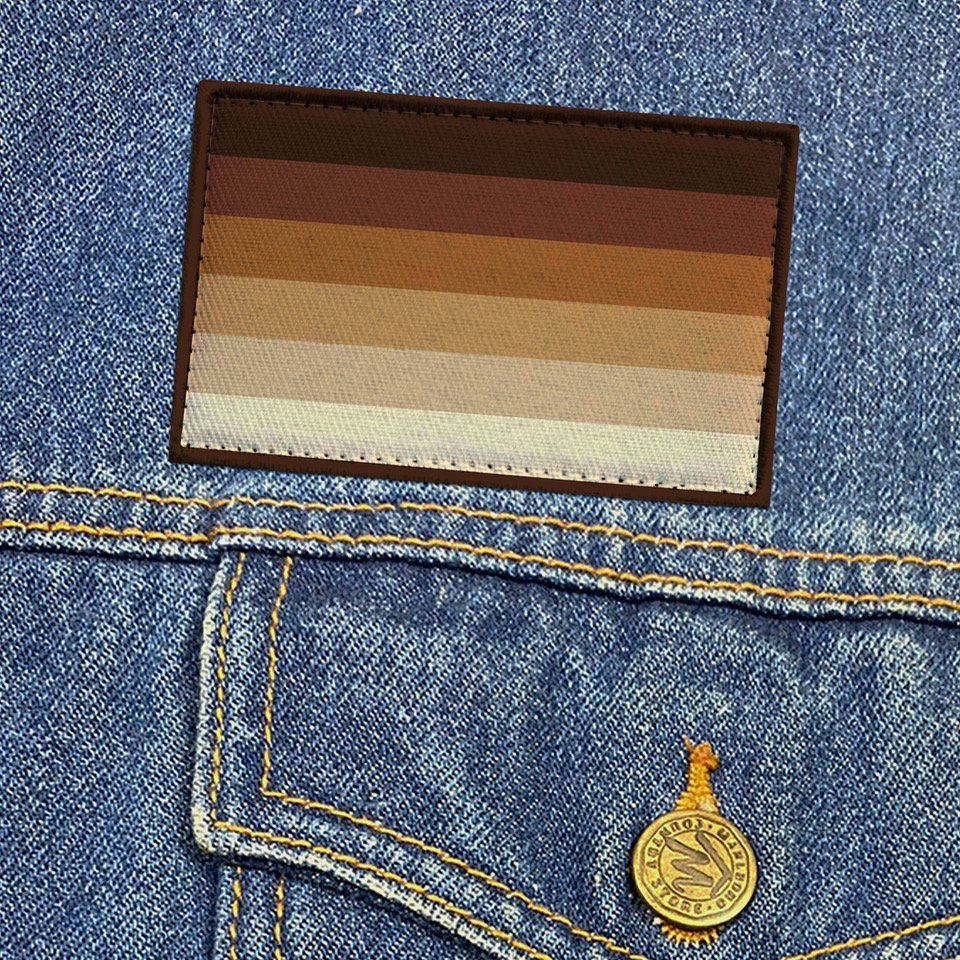
For me this is personal, but it’s also here for everyone. I’m a humanist and reject all caste systems of oppression. I don’t think I’m the only one. in fact I know I’m not.
Retail shops, restaurants, galleries and museums can display the “equity flag” the same way they might display the rainbow flag to show that everyone is welcome in their establishments.
Politicians can wear the equity flag pin on their lapels, as a companion for their state or country’s flag pin. The rest of us might carry a tote or wear a patch or end our emails with a digital signature including the equity flag.
Why? Because that conversation with my pal who had just become a father ended with him saying: “… at this point in America, I need to see some sort of sign about where people stand, before I give them any more of… me… my time… or my money.”
I created this initially as an answer to his call for a sign—he loved it and I felt encouraged—then I used it at a Pride event on the flip side of the rainbow and trans flags, to show how it could work as more than a sign or a sticker. More people thought it felt like home and were surprised something like it didn’t already exist. Then came research into colors to represent the range of human skin tones and conversations with advisors, activists and social justice experts who also supported my thinking and visual representation which led to this orientation, from dark to light to mirror the now ubiquitous Rainbow /Pride flag. I hope it feels like home to you too.
Sharoz
Please follow @equityflag on Instagram and DM me for stickers and share any thoughts on how to get equity flags to every school to put on their flag poles next to the US or state flags and pins on lapels, some of which will soon be available on this site for download and ordering, along with flag pins, patches, and such.
Media & collaboration inquiries, please email, thank you!